Revenant
Interview with the VampireRevenants are the Eastern European vampire corpses that Louis and Claudia encounter during their journey from New Orleans toward the Black Sea. They are not simply another name for ordinary vampires: they are animated, decaying bodies whose minds have been extinguished, whose movements are governed by hunger, and whose existence forces Louis to question whether consciousness, identity, and immortality are separable. Their discovery destroys the hope that ancient vampires will provide clear answers about the nature of vampirism, yet it also creates the central mystery of the journey: how creatures so empty could originate, reproduce, and continue to walk among the living.
Definition and Appearance
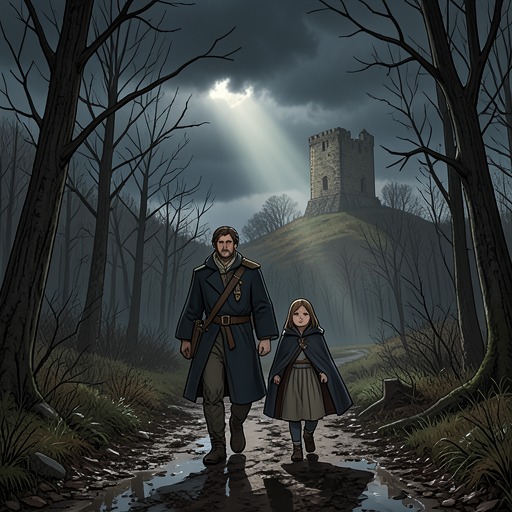
Revenants appear as living dead rather than as fully conscious supernatural persons. Louis describes finding them in Transylvania, Hungary, Bulgaria, and neighboring rural regions, where peasants already believe that the dead walk and where vampire legends remain part of local knowledge. He encounters only a handful, and sometimes Louis and Claudia can do no more than watch them from a distance. Their heads wag with a bovine, vacant motion; their shoulders are haggard; and their clothing is rotted and ragged. They do not display the intelligence, language, or self-awareness that Louis associates with himself, Claudia, or Lestat.
One of the clearest examples is a woman who has been dead for only a few months. Villagers recognize her, but recognition does not restore the person she was. She flees through the forest in a white burial gown soaked with dried blood, her fingers still caked with grave dirt, while her eyes remain empty pools reflecting the moon. Louis finds no secret or truth in them, only despair. The image joins the revenant's physical condition to its mental one: the body has escaped the grave, but the human subject has not returned with it.
The revenant's body is therefore a site of failed preservation. In the written accounts Claudia studies, Eastern European communities burn vampire remains, stake the heart, and sever the head. Such practices treat the corpse as both a contagious danger and an object requiring ritual disassembly. The measures imply that the revenant's threat lies not in a hidden personality but in the persistence of a body that refuses to remain properly dead.
Encounter During the Eastern European Quest
Louis and Claudia seek the revenants after leaving New Orleans because Claudia wants knowledge of their origins and a connection with others of their kind. Their route leads toward Varna, the Black Sea, and the rural countryside of the Carpathians. Claudia reads travelers' accounts written by priests and scholars, treating these records as guides to a vampire history that Lestat never explained. The books describe the burning, staking, and decapitation of suspected vampires, giving the search a documentary and ritual dimension rather than the atmosphere of a purely fanciful adventure.
The encounters disappoint almost immediately. In every village where Louis and Claudia find a vampire, the pattern is essentially the same: a mindless corpse, moving without meaningful speech or discernible thought. These beings do not form the ancient community Claudia imagines, nor do they possess the accumulated wisdom that could explain the creation of conscious vampires. Their presence makes the journey more desolate because the sought-for evidence is available only in the form of bodies that cannot interpret their own condition.
The contrast becomes sharper after the pair have already feared that they killed Lestat. Louis had imagined that Lestat, who made both him and Claudia, might possess some exceptional knowledge or power. The revenants make that possibility seem both more necessary and less credible. If Lestat had been a sorcerer or possessed the powers of a witch, Louis could have understood how he might have wrested a conscious existence from the forces that produced these monsters. But Lestat's limits had seemed familiar to Louis, and the revenants therefore raise the disturbing possibility that their own condition is not an exotic exception but a distorted version of the same process that created Louis and Claudia.
Mindlessness, Hunger, and Possible Origins
Claudia tries to explain the revenants through the circumstances of their transformation. She repeatedly reconstructs the night in New Orleans when Lestat made her a vampire, asking what might have happened if a newly transformed creature had been placed in a grave and sealed inside until hunger drove it to break through the stone. In her theory, the body might preserve itself after the mind had been starved beyond recovery. The result would be a creature capable of ravaging whatever it encountered, but incapable of thought, memory, or moral judgment.
Her theory accounts for the revenants' behavior without explaining their beginning. Claudia understands that such creatures reproduce their own kind, but she cannot identify the first source. Her question about where the process starts becomes more troubling because the revenants appear to possess a form of vampiric continuation without the inward life that gives vampirism its apparent identity. They survive, feed, and perhaps propagate, but they do not seem to know what they are.
Louis adds another possibility through his own fear. Claudia asks why he cannot do what Lestat did and make another vampire. Louis refuses to answer because creating another being in death seems monstrous to him, and because he fears that he may already have produced revenants without knowing it. He wonders whether a few drops of his blood mixed with a mortal's blood might create a monster if the mortal heart survived the initial attack. Emily, the Englishman Morgan's companion, becomes one imagined example: her heart may have failed under terror, but other victims might have survived long enough to become mindless offspring.
This suspicion links the revenant to a concealed network of accidental transmission. Louis insists that he has never created such creatures and explains that Lestat drained him almost to death before returning blood mingled with his own. Yet Claudia presses the possibility that some unnamed survivors, abandoned after an incomplete transformation, may have lived for a day or a week before sunlight or a mortal attacker destroyed them. The revenant is thus not only an Eastern European corpse encountered in a graveyard; it is also the feared consequence of an act of blood exchange whose results the creator may never witness.
Contrast with Conscious Vampires
The revenant's defining contrast is with Louis and Claudia. Louis experiences guilt, memory, aesthetic longing, grief, and philosophical doubt; Claudia pursues knowledge, analyzes the mechanics of transformation, and seeks her own kind. Even their violence is shaped by reflection and argument. The revenants possess none of this inward complexity. Their bodies move, but their minds do not accompany them in any recognizable form.
This distinction makes Lestat's supposed death especially unstable. Louis remembers Lestat's voice and face throughout the empty nights of Eastern Europe and begins to want him alive again, even while fearing that he and Claudia may have destroyed him. The revenants become the only vampires Louis finds there, and their emptiness turns Lestat into a haunting absence: if he survived only as one of these creatures, then the conscious, difficult personality Louis remembers would have been reduced to instinct and decay. The possibility is more frightening than simple death because it would preserve the body while annihilating the person.
The revenants also illuminate the difference between physical immortality and meaningful life. Claudia wants answers and communion with her own kind, but the beings she finds offer no fellowship. They demonstrate that remaining animated is not equivalent to remaining alive in the human or intellectual sense. Louis's fear is therefore not merely of death; it is of a survival stripped of language, choice, and memory.
Narrative and Thematic Significance
Revenants overturn the expectation that a journey toward the origins of vampirism will lead to deeper knowledge. Claudia's books promise an ancient tradition, and the route toward the Carpathians promises contact with an older world. Instead, the travelers encounter village corpses, folk practices, and the same vacant condition repeated across different countries. The Old World supplies persistence without revelation.
Their presence also connects vampirism to contamination and the management of dangerous remains. Grave dirt, dried blood, burial clothing, stakes, fire, severed heads, and burned bodies all mark unstable boundaries between corpse and person, death and life, folklore and testimony. The communities that destroy these bodies respond to a threat that is at once physical, ritual, and social. Claudia's search for knowledge is consequently entangled with the practical question of how a community identifies, contains, and eliminates a body that has crossed the boundary of death.
The revenants finally prepare the emotional and intellectual turn away from Eastern Europe. Exhausted by the mindless creatures and by the unanswered question of their origin, Louis and Claudia abandon the hope that the countryside will explain them. Their attention shifts first toward Vienna and then toward Paris, where Claudia concludes that they need their own language and their own people. The search for the revenant therefore ends not in discovery but in redirection. It teaches Louis that the damned may not possess the answers the living seek from them, and it leaves him with a more terrifying question: whether consciousness is a rare achievement within vampirism, or only a temporary resistance to the same emptiness that governs the dead who walk.